

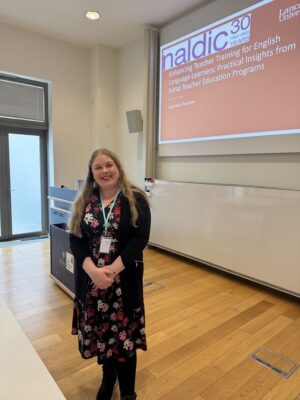
 NALDIC friend and EAL community member Dr Gabrielle Flockton reflects on the 33rd NALDIC Conference
I still remember my first days supporting newly arrived learners through a volunteer refugee and asylum seeker group. Teaching science, English, history, and occasionally maths, I quickly faced practical questions about how to help them access the curriculum. In our small team, some TESOL qualified, some not, we were largely figuring things out on our own. I often felt like we were navigating complex linguistic and cultural challenges in isolation.
Discovering NALDIC changed that. The NALDIC Quarterly 14.1 “The Conference Edition: EAL for a New Curriculum” highlighted how others were grappling with academic English, scientific literacy, and mathematical word problems; questions I was asking myself daily. The NALDIC blog brought this connection to life. Posts like Colourful Semantics in Action offered practical classroom strategies, while Embracing multilingualism in schools through makerspace pedagogies reminded me that learners’ linguistic and cultural resources are strengths to be harnessed creatively. The EAL Journal reinforced the same lessons at a broader level. The many powerful contributions to the issue about Schools of Sanctuary showed that the challenges I faced were part of a wider professional conversation.
Recognising my own questions in these publications, alongside my growing experience and professional development in the field shifted my teaching from improvisation to informed practice. What once felt isolating became connected, reflective, and evidence-based, showing me that inclusive education for multilingual learners is built not in isolation, but through shared knowledge and professional dialogue. This journey, from volunteer to teacher-researcher, has shaped how I teach, research, and think about language, identity, and access to curriculum.
Since those early days, I have dedicated myself to exploring EAL from different angles, including research. My MA research on teacher educators’ perspectives on preparing student teachers to work with EAL, and my PhD research, Evaluation of Initial Teacher Education programmes for quality education of English Language Learners in England: provision, practice, expectations, allowed me to understand theory and practice, and how they evolve. Alongside this, I witnessed policy shift; EAL references disappearing and reappearing in Department for Education and Ofsted guidance, resulting in a confusing landscape for new teachers and teacher educators alike. What remained consistent, however, was the supportive professional community that NALDIC provides, offering resources, discussion, and connection for educators working with learners who have English as an additional language.
So why attend an in-person conference?
Every time I attend one, I’m reminded that the need for EAL support is still very real. Official figures suggest that around 21.4% of pupils in England have their first language recorded as something other than English in the 2024–2025 academic year — though, of course, these numbers are estimates, and no dataset can fully capture the rich and varied language experiences of children in our classrooms.
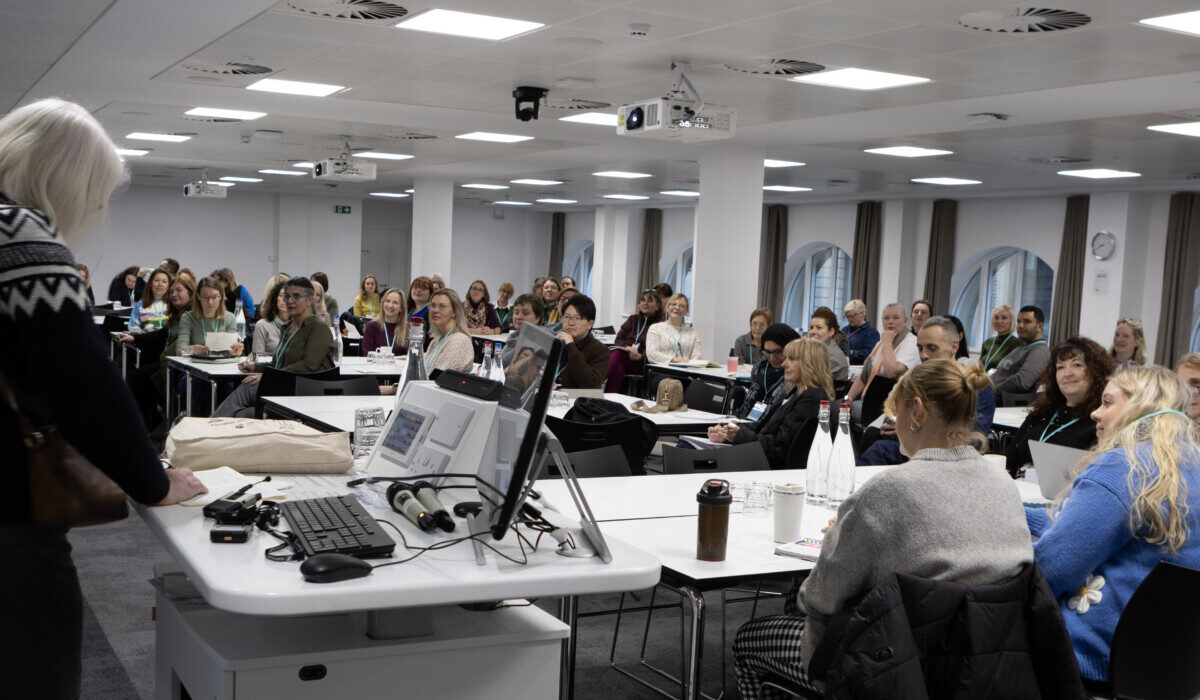
At an in-person NALDIC conference, I encounter teachers, managers, and academics from all over the country, each bringing their own experiences with EAL learners. There’s something energising about being in a room where everyone “gets it”: we can share real-life classroom stories, discuss challenges, swap practical strategies, and reflect on what works and what doesn’t. I always leave feeling inspired — reminded that I’m not alone, that there’s a whole community of people striving for the same thing in their own contexts. Whether it’s discovering new resources, connecting with regional or special-interest groups, or just hearing fresh perspectives, the conference is a place to recharge, reflect, and reconnect with the shared purpose of supporting multilingual learners.
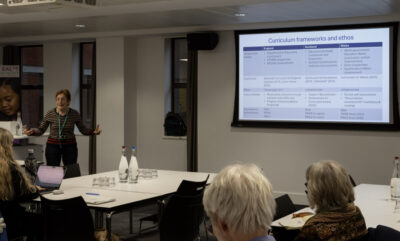
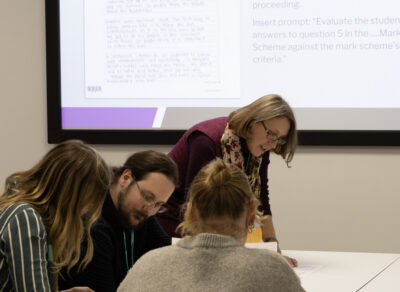
For me, one of the highlights of the conference was the opening keynote delivered by David Morrison Love and Constant Leung. David’s discussion on assessment really made me stop and reflect on my own practice. He reminded us that classroom assessment can sometimes be used reductively; just as techniques to apply, or merely to judge performance, and yet, perhaps most strikingly for me, he highlighted that “learning can occur even when no discernible changes to performance are seen”. That idea resonated deeply; it reminded me that teaching is not just about grades or measurable outcomes, but about supporting the growth of knowledge and confidence over time. His closing thought that “feedback should be a dialogue and an extension of the learning conversation – it’s feeding back not just to reduce error, but to extend and carry forward what they’re learning” felt like a practical and inspiring call to action.
Constant Leung also left a strong impression with his reminder that “Assessment is not in English only — we carry all of our languages in every encounter.” For me, this reinforced a central truth of working with multilingual learners: language is never a single, isolated tool; it’s part of identity, culture, and knowledge, and assessment should reflect that richness. Together, their talks reminded me why I, and perhaps many educators, came into teaching: learning is about progression, making mistakes, and expanding understanding, and while grades matter, the broader growth of knowledge and confidence should never be overlooked.
Voices from the community
For me, one of the most memorable aspects of the conference isn’t just the keynote speakers, but the conversations that happen in workshops and talks led by practitioners in schools. I loved listening to colleagues share how they assess EAL learners in their own contexts, and I found the chance to join workshop discussions with exhibitors creating materials alongside NALDIC particularly inspiring.
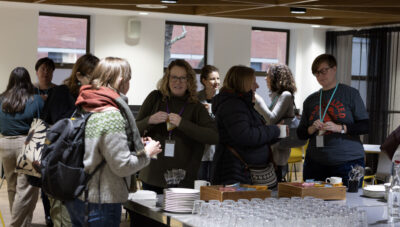
It’s also the small, informal moments that stay with me: chatting over refreshment breaks, catching up with peers at lunch, swapping ideas about books and classroom resources, or discovering something new at the exhibitor stands. Those interactions reminded me that I’m part of a community of educators who care deeply about their EAL pupils, who are committed to developing their practice, and who are open to sharing solutions and ideas. For me, those moments make the conference feel like a safe and energising space — a place where you can pause, reflect, and feel genuinely welcomed.
Looking ahead to 2026, I’m excited to see what the next theme will be and to continue these conversations, exchanging ideas, reflecting on practice, and connecting with a community that keeps both my teaching and research energised.
 Find out more about multilingualism
- Join one of our Regional or Special Interest Groups
- Learn more about the last NALDIC annual conference
- Do you have a story to share? Write a post for the NALDIC blog