


Dr James Algie, on behalf of the Progression in Primary Languages project team, shares some insights on schools’ EAL classification
All primary schools in England must report which of their pupils have English as an Additional Language (EAL). This helps the government, schools and teachers to provide additional support for multilingual pupils, including those whose EAL status might not otherwise be obvious. However, our recent research indicates that our schools may be more linguistically diverse than official EAL figures suggest.
Since 2022, our Progression in Primary Languages (PiPL) project at the University of Reading has been building a detailed picture of language learning in 17 primary schools. We have been following the progress of over 2,000 children in French, German and Spanish, as well as exploring the context in which foreign language learning takes place.
The scope of the PiPL project in numbers
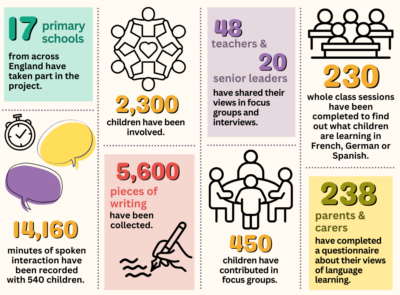
As well as tracking the progress of the pupils’ language skills in areas such as vocabulary and grammar (Kasprowicz, 2025), we also interviewed headteachers, teachers, parents and the children themselves to learn more about their experiences of and attitudes towards languages at home and at school. As part of our effort to understand the context in which language learning takes place, we asked parents and children whether they use languages other than English at home. And we got some different answers to those provided by schools.
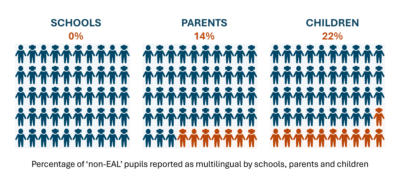
We compared information from three separate sources – questionnaire responses from children and parents, and the demographic information reported by schools – and we had complete data for 117 of our child participants. 26 of the children were classified by schools as EAL. Of the remaining 91 ‘non-EAL’ pupils, 22 per cent told us that they were actually multilingual. When we asked the same question of parents, they identified 14 per cent of non-EAL children as being multilingual.
So, why does this misalignment matter?
First, this means that our schools and our pupils are probably more linguistically diverse than we are giving them credit for. Masking this diversity risks devaluing the heritage languages being used at home. Even when children are accurately classified as EAL, data reported by schools tells us relatively little. Many children have wonderfully diverse linguistic experiences at home and through community-based initiatives, such as complementary schools (Silvestri, 2025). This diversity cannot be reflected by a simple, binary EAL status.
Second, children whose multilingualism is being overlooked by schools are often those whose English is seen as ‘good enough’ not to need extra support. This can mean they miss out on provision altogether because their needs are not fully recognised. As a result, resources may be directed elsewhere, and language support programmes may not reflect these children’s real linguistic experiences.
What can be done?
This is not just a primary school problem. Previous research has identified similar issues of linguistic representation in secondary schools (Liggins, 2021), and even in the national census. This highlights the need to better capture children’s linguistic diversity by using multiple and more nuanced sources of information.
The sole reliance on English proficiency to inform a binary category, such as EAL, risks oversimplifying multilingualism. Children’s language backgrounds are far more nuanced, and their full linguistic repertoires should be wholly recognised, celebrated and nurtured.
References
Kasprowicz, R. E. (2026). Is progression in primary languages possible? Reflections from a large-scale longitudinal research study. The Language Learning Journal, 54(1), 73–81.
Liggins, S. (2026). ‘Why would you wanna do your own language, who you gonna impress?’ Adolescent heritage language speakers’ perceptions of their plurilingualism. International Journal of Multilingualism, 1–27.
Silvestri, C. (2025). Complementary schools as ‘breathing spaces’: Identity, multilingualism and critical pedagogies in heritage language education. Language and Education, 39(2), 470–488.
Find out more about multilingualism
- Join one of our Regional or Special Interest Groups
- Learn more about the last NALDIC annual conference
- Do you have a story to share? Write a post for the NALDIC blog