

Denise Amankwah, doctoral researcher from the University of Essex, shares her experiences of being involved in NALDIC’s RIGS and SIGs
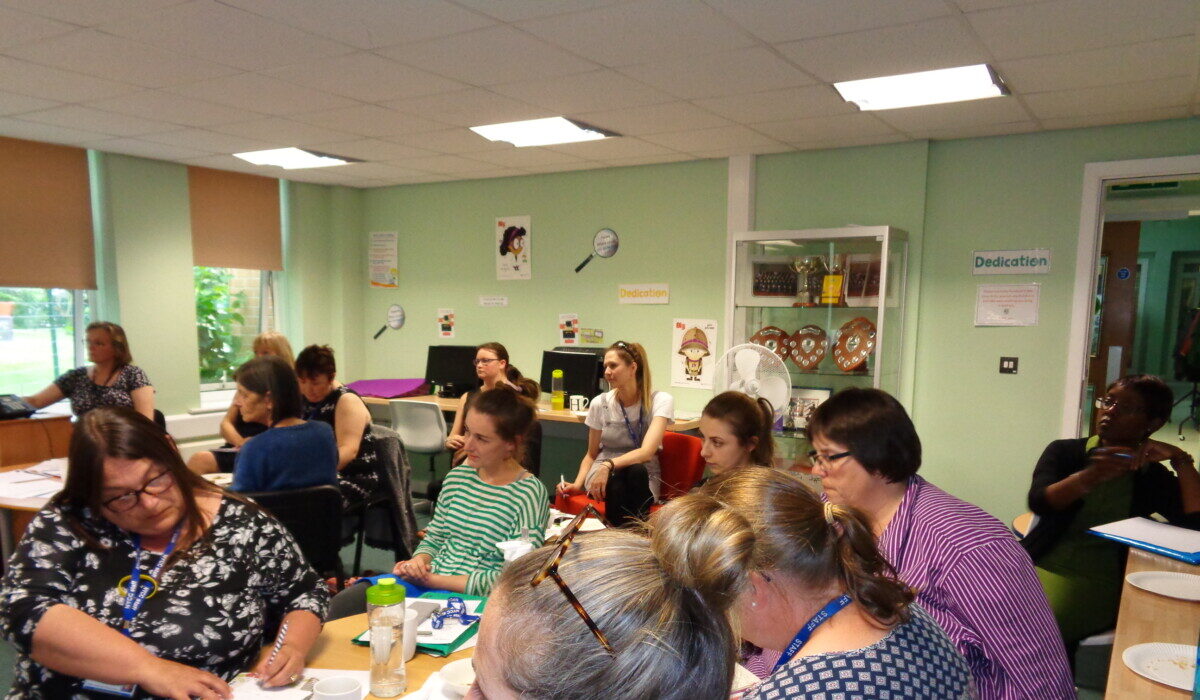
As one of NALDIC’s Business Support Officers, I have the pleasure of being involved in all RIGs and SIGs. NALDICs Regional Interest Groups (RIGs) and Special Interest Groups (SIGs) provide a free, relaxed and welcoming space for educators, researchers and school leaders to come together around issues that matter to multilingual learners. Across the country, our volunteer convenors host meetings focused on the latest policy updates, professional dialogue, reflection, new learning and connecting research with classroom practice.
Recent meetings have highlighted the breadth of issues currently shaping multilingual education, while also revealing some common threads that run through our work.
A particularly timely discussion took place during the 11th EAL Coordinators SIG meeting, where Megan Greenwood from Schools of Sanctuary invited participants to consider what it means to be genuinely welcoming for all. The session encouraged attendees to move beyond viewing welcome as a one-off event for newly arrived pupils and instead to think about belonging as something that is continuously nurtured through school culture and everyday practice. Participants reflected on how multilingual learners and their families experience schools and the role that family engagement and inclusive policies play in creating environments where everyone feels recognised and valued.
Questions of inclusion and belonging were also evident in discussions around
multilingualism more broadly. Across several NALDIC events, speakers have challenged
deficit perspectives of multilingual learners and instead highlighted the knowledge,
experiences and linguistic resources that pupils bring to school. This asset-based approach
continues to underpin much of NALDICs work and reflects a growing recognition that
multilingualism should be viewed as a strength rather than a challenge.
Literacy has been another important focus. The 16th West Midlands RIG session on Reading
as a Learner of EAL reflects increasing interest in how schools can support reading
development for pupils learning through English as an additional language. We were joined
by guest speakers Catharine Driver from National Literacy Trust and Literacy Consultant Bex
Shore. As schools respond to the National Year of Reading, discussions around literacy are
becoming increasingly relevant. Attendees left the session with an improved understanding
of key issues to consider when planning reading provision for secondary-based pupils in
particular.
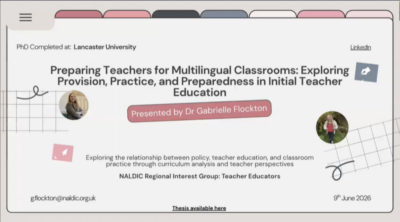
Most recently, teacher educators recently gathered to attend the 6th Teacher Educators
SIG, with Dr Gabrielle Flockton as the guest speaker sharing findings from her PhD research. The group examined the relationship between policy, teacher education and classroom
practice by analysing curriculum. A recorded version of her presentation, the Powerpoint
handout and her full thesis can be found in the members only of the Teacher Educators SIG
page.
The coming weeks continue this rich programme of professional learning. The 23rd Northeast
RIG will focus on transition and support for new arrivals, while the 42nd Yorkshire & Humber RIG will take place in person and explore reading with multilingual learners. And on the 26th
Berkshire and Hampshire RIG is titled ‘Inclusive education and linguistic ableism’ by
Valentina Migliarini from the University of Birmingham. These discussions remind us that
multilingual learners experiences are shaped not only by language but also by broader
issues of access and inclusion.
What connects all of these conversations is a commitment to creating educational
environments where multilingual learners can thrive. Whether discussing welcome, reading,
oracy, assessment or newcomer experiences, participants typically end up returning to the
same core principles in their discussions: recognising multilingualism as an asset, valuing
learners identities and ensuring equitable access to learning opportunities.
NALDICs RIGs and SIGs remain an important space for these conversations. They provide
opportunities to learn from colleagues across phases and sectors, engage with current
research and share practical strategies that can be taken back into schools and classrooms.
We are grateful to our convenors, speakers and attendees who continue to make these
networks such vibrant communities of practice.
To find out more about the RIGs and SIGs you an join visit the RIGs and SIGs page, and to find out about upcoming meetings, visit the NALDIC Events calendar. We look
forward to welcoming you to a future RIG or SIG event!
Find out more about multilingualism
- Join one of our Regional or Special Interest Groups
- Learn more about the last NALDIC annual conference
- Do you have a story to share? Write a post for the NALDIC blog